

If you’re a dietitian with a website, there’s a good chance you’ve heard over and over again that SEO matters. And while that’s absolutely true, what’s not talked about enough is that sometimes improving your SEO isn’t about adding more things to your strategy, but rather fixing things that could potentially be hurting it.
After working with tons of dietitians on website projects, we’ve realized that most business owners are actively trying to improve their SEO.
A lot of them are blogging, utilizing keywords, and making sure their copy clearly conveys who they are, who they help, and what they offer.
But what often happens is that there are small SEO mistakes happening behind the scenes that impact visibility, user experience, and search rankings without them even realizing it. The good news is that most of these SEO mistakes are fixable once you know what to look for!
So in this blog post, we’re breaking down the most common SEO mistakes to avoid for dietitian websites so you can create a stronger foundation for long-term visibility and growth.
10 SEO Mistakes to Avoid On Your Dietitian Website
Keyword Stuffing
Starting off with a big one, one of the biggest SEO mistakes to avoid as a dietitian is keyword stuffing.
Keyword stuffing happens when you overuse the same keyword repeatedly throughout your website in an attempt to rank higher on Google.
For example, if your keyword is “sports dietitian,” keyword stuffing might sound something like:
“If you’re looking for a sports dietitian, our sports dietitian services help athletes who need a sports dietitian…”
You get the idea!
Not only does this make your content awkward to read, but search engines have become smart enough to recognize when content is being overly optimized.
Instead, your keywords should feel natural and conversational.
➡️ THE FIX: Focus on creating genuinely helpful content first (like through your blogs!) and strategically weaving your keywords throughout all of your pages in a way that feels human!
Targeting Broad Keywords
In addition to keyword stuffing, another common SEO mistake to avoid when it comes to keywords specifically is trying to rank for keywords that are wayyyy too broad.
For example, words like:
- Dietitian
- Nutritionist
- Healthy eating
- Nutrition help
These keywords are incredibly competitive and often too vague to attract qualified traffic.
➡️ THE FIX: Instead, focus on more specific keywords that align with your specialty and ideal client.
For example:
- Virtual dietitian for PCOS
- Eating disorder dietitian in Nashville
- Sports nutrition counseling for teen athletes
- Gut health dietitian for women
Specific keywords may have lower search volume, but they typically attract people who are much more likely to inquire and that’s ultimately the goal!
Not Using Alt Text For Images
Moving on from keywords, alt text is one of the easiest SEO opportunities that many dietitian websites completely overlook.
Alt text is a short description added to images that helps search engines understand what the image is showing.
➡️ THE FIX: Instead of uploading an image with no description, ALWAYS add alt text for both accessibility and SEO purposes.
Here’s an example of what this can look like:

Because so many website owners skip this step, it’s actually a relatively simple way to strengthen your website without having to put in a ton of effort!
Ignoring the Mobile Responsiveness of Your Website
More than HALF of all website traffic now comes from mobile devices, which means that Google primarily evaluates websites based on their mobile performance.
If your website isn’t mobile-friendly, it’s more common for visitors to leave your site quickly – even if you actually offer what they’re looking for!
If they’re browsing on mobile and can’t find something fast, you can consider them gone!
Some common mobile issues include:
- Tiny text that’s difficult to read
- Buttons that are hard to click
- Images that load incorrectly
- Spacing issues
- Slow load times
And from an SEO perspective, this matters a LOT. Search engines prioritize websites that create a positive mobile experience, so if your website is difficult to navigate on mobile, it can negatively impact both your rankings and your conversions.
➡️ THE FIX: if you’re designing your dietitian website from scratch, we recommend working with a website designer that prioritizes mobile optimization.
And if your website is already launched, we recommend regularly checking your website from your own phone (not just your desktop) to ensure that everything is loading and working exactly as it should!
Checking your mobile responsiveness should be a consistent part of your private practice website maintenance, so if you don’t already have that on your ongoing list of things to check, we recommend adding it!
Using Incorrect Formatting Across Your Website
Similar to adding alt text, formatting plays a much bigger role in SEO than many people realize. Specifically, your heading structure helps search engines understand the hierarchy and organization of your content.
For example:
- Your main page title should typically be an H1
- Main sections should use H2 headings
- Supporting points underneath should use H3 headings
Here’s what this looks like in action on a blog post:
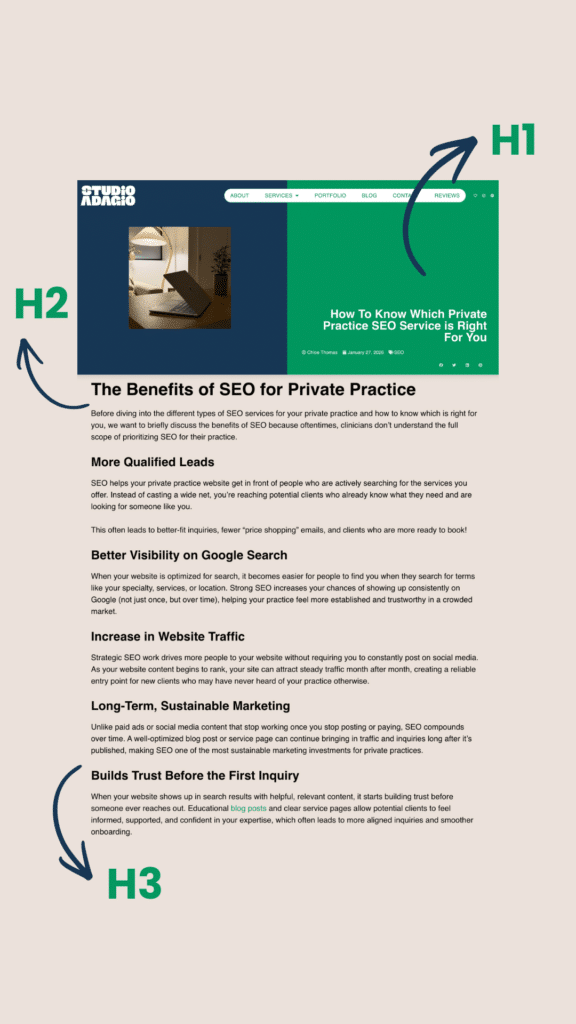
When headings are used incorrectly (or worse, skipped entirely), it can make your content harder for search engines to interpret and it also impacts readability for users.
➡️ THE FIX: ensure that you’re using H1s, H2s, and H3s throughout all of your website pages, including your blog posts.
Good formatting helps both people and search engines navigate your content more effectively!
Using Default Website Slugs
A website slug is the part of a URL that comes after your domain name and one of the worst SEO mistakes you can make is using the default website slugs that populate after you create a new page or new blog post.
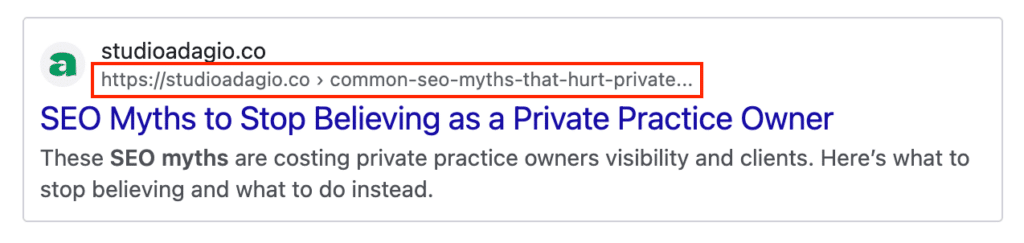
This commonly looks something like this: yourwebsite.com/post-74829
This is one of those small SEO mistakes that seems insignificant, but it matters a LOT!
➡️ THE FIX: manually update your website slugs for every page and blog post on your website.
Your website slug is a key spot to include keywords which is why it’s so important that you manually update them to read more like this: yourwebsite.com/sports-nutrition-counseling
Clean, descriptive URLs help search engines understand your content, improve user experience, and make your pages look more professional.
This is especially important for blog posts, which often have longer titles! For blog posts, your URL doesn’t need to include every word from the title – it just needs to clearly communicate the topic.
For example, this blog post is titled ‘Common SEO Mistakes to Avoid on Dietitian Websites,’ but we manually adjusted the slug to simply read: ‘common-seo-mistakes-to-avoid.’
This shortens the slug while still clearly communicating the blog topic and including our target keyword!
Forgetting to Update Meta Titles and Descriptions
Meta titles and descriptions are what people see in search results before they click onto your website. And if those feel like fancy words for you, we break down some of the most common SEO terms here!
Meta Title (also referred to as SEO title) = clickable headline that appears in search results and should include your primary keyword and entice users to click.
Meta Description = short summary shown beneath the SEO title in search results.
They look like this:
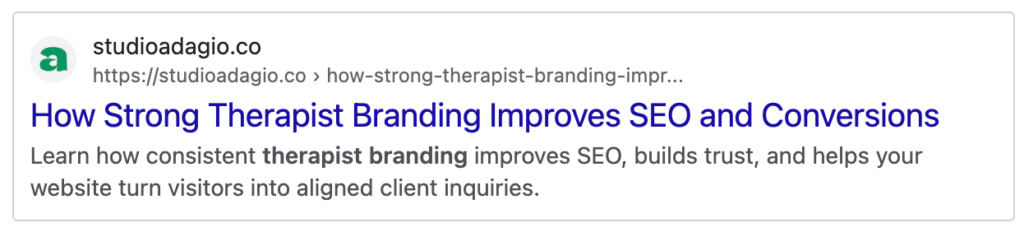
This is really where a lot of your SEO results are generated from because this is the information that search engines are looking for, yet many dietitian websites leave these completely untouched.
Or worse, similar to slugs, they let the website platform auto-generate them.
➡️ THE FIX: manually update your meta titles and descriptions to naturally incorporate your keywords.
These two things are truly what create your website’s first impression on Google and can significantly improve your website click-through rates!
Publishing Inconsistent Blog Content
Aside from the technical side of things, one of the biggest misconceptions about SEO is that you can publish a few blog posts and instantly start ranking.
While it’s true that some content is better than no content, we really encourage our SEO clients to publish consistent blog content because that’s truly what makes SEO work!
➡️ THE FIX: create some sort of consistent blog content rhythm.
Now, this doesn’t mean you need to blog every single week if you don’t have the capacity for it. We simply want you posting new, fresh content on some type of consistent basis that makes sense for you and your business.
Because the thing is, search engines tend to favor websites that are actively updated with relevant, high-quality content!
Not to mention, consistency also helps build topical authority over time.
For example, if you consistently create content around gut health, eating disorders, or sports nutrition, search engines begin associating your website with those subjects.
Not Internally Linking Between Pages
When you consistently post new blog content for your dietitian website, you’ll have more chances to internally link between pages, which is something that search engines LOVE!
Internal linking is when you connect related pages and blog posts throughout your website.
Strategically doing this helps users stay on your website longer, search engines understand your content structure, and spread authority across your website – all of which directly impact your SEO rankings!
For example:
- Linking a blog post to a related service page
- Linking between related blogs
- Connecting FAQs to service offerings
Throughout this blog post, we’ve internally linked to other blog posts on our website because 1) it helps you dive into more content that’s relevant and helpful to what we’re already talking about and 2) it helps our SEO!
What’s important to recognize here, however, is that you don’t want to internally link something “just because.”
You DO want to make sure the content you’re linking to is relevant and topic-adjacent to what you’re already talking about. Otherwise, it will feel random and potentially confusing to your reader.
Overall, internal linking is one of the most simple ways to strengthen your SEO strategy without creating brand new content.
Treating SEO Like a One-Time Task
Lastly, this may be the biggest SEO mistake of all and it’s believing that SEO is something you’ll work to improve once and be done with.
The truth is that SEO is not something you’ll ever “finish.”
It’s an ongoing strategy that requires consistent work overtime because of various factors, like search behaviors changing, competitors evolving, services shifting, and your audience growing.
As these things change, your SEO will ebb and flow and that’s OKAY!
The important thing is that you always have your eye on it and you’re always making it a priority to implement SEO best practices to ensure that your dietitian website stays on top.
The dietitian practices that see the best long-term results are the ones that:
✔️ Continuously update their websites
✔️ Refresh old content (this is sometimes even more important than creating new content!)
✔️ Monitor rankings (do this through an SEO tool – our favorite is SEMrush!)
✔️ Improve technical performance (like mobile optimization, page load speed, etc)
✔️ Create strategic new content over time
At the end of the day, SEO is momentum-based and small, consistent improvements usually outperform random bursts of effort!
The Best Way To Fix Common SEO Mistakes
If you’re reading this and realizing you’ve made a few of these common SEO mistakes on your dietitian website, don’t panic.
Most business owners have made these same SEO mistakes before and the good news is that they’re all fixable!
The important thing is simply becoming aware of what may be holding your website back so you can start making intentional improvements moving forward.
If you aren’t sure where your website stands when it comes to SEO and you want a clear picture so you have a better idea of where to spend your time for improvements, our Private Practice Website Health Scorecard is for you!
As mentioned above, a lot of private practice owners think SEO means only keywords and blog posts. But if your website foundation, meaning the technical, backend aspects aren’t healthy, Google can’t properly read, rank, or trust your content. This scorecard will help you see how your website is actually performing!
Once you know how your website is performing, if you know you need more hands-on support, we’re here to help!
At Studio Adagio, we help dietitians create websites and SEO strategies that support long-term visibility, authority, and aligned client inquiries.
From technical SEO improvements to strategic blogging and website optimization, our goal is to help your practice get found by the people already searching for the support you provide.
At the end of the day, your website should be working for your business, not against it.
So if you’re ready to fix one or more of these common SEO mistakes and don’t want to do it alone, CLICK HERE to learn more about SEO Services designed especially for private practices!