


As SEO strategists for private practice owners, we talk a lot about conducting keyword research to ensure you’re creating the right type of content for your audience. That’s why we’ve put together a keyword research checklist to serve as a step-by-step guide to make this process less intimidating and more strategic.
If you’re new to SEO (search engine optimization), keyword research can feel a bit like solving a complicated math equation — one where you’re crossing your fingers and hoping for the best. But that’s actually the opposite of how keyword research should feel.
When you know how to do it correctly, it’s not difficult or overwhelming. In fact, it can even feel fun because you’re gathering real data about what your ideal clients are already searching for online and using that information to create a clear, intentional content plan.
To make keyword research approachable, our keyword research checklist walks you through each step so you can create content backed by SEO strategy — not just ✨vibes✨ — helping your website be found by the people who need your services most.
What Are SEO Keywords?
Before we get into the keyword research checklist, let’s make sure we’re on the same page about what SEO keywords even are. Because again, if you’re new to SEO, all of these terms can feel a little jargony.
Put simply, SEO keywords are the words and phrases people type into search engines like Google when they’re looking for answers, support, or services. For private practice owners, keywords often reflect the problems potential clients are experiencing or the solutions they’re actively searching for.
For example, someone might search for phrases like “therapy for anxiety,” “nutrition counseling near me,” or “how to manage stress naturally.” These searches tell you exactly what your audience is thinking about, struggling with, or ready to invest in.
When you use relevant keywords intentionally throughout your website content – including blog posts, service pages, and even page titles – you’re helping search engines understand what your site is about and that makes it easier for Google to connect your website with people who are searching for what you offer.
Without keyword research, content creation becomes guesswork, but WITH it, your content is grounded in clarity and strategy!
Why Does Keyword Research Matter?
So that brings us to the question of if keyword research really even matters? Like is it truly a necessary step when it comes to your overarching SEO strategy as a private practice owner?
Short answer: absolutely YES! If you want to give your website and content a fair shot at being found, keyword research is not something you want to skip.
But here’s the long answer to help you fully understand why keyword research matters for your private practice:
Keyword research is one of the most important foundations of SEO, especially for private practice owners who rely on organic traffic to grow their visibility. When done well, keyword research ensures that the time and energy you put into content creation actually supports your business goals.
For example, let’s say your goal for the next year is to book more private-pay clients for anxiety-focused services. Without keyword research, you might write broad blog posts like “Why Therapy Is Important” or “Mental Health Tips for Everyday Life.”
While well-intentioned, those topics don’t necessarily attract people who are actively looking for your specific services. With keyword research, you might discover that people in your area are searching for phrases like “therapy for anxiety in [city],” “high-functioning anxiety therapist,” or “signs of anxiety in women.”
Knowing those search terms, you can then create content around those keywords, allowing your website to show up for searches that align directly with your offerings – meaning the traffic you attract is more likely to turn into inquiries, consultations, and booked sessions!
Keyword Research Checklist for Private Practice Owners
Now that you have clarity around what SEO keywords are and why keyword research matters, let’s dive into your practical keyword research checklist to help you do it with ease:
✅ Get Clear on Who You’re Trying to Reach
Before you open a keyword research tool, start by clarifying who your ideal client is and what they’re searching for.
If you’ve been in practice for a while now, you likely already know your ideal client, so the next step is to think about the questions clients currently ask you – whether it’s during sessions, inquiry emails, or discovery calls. Those real-life conversations are often the clearest clues to what people are typing into Google!
If you’re just starting out in your practice and are still refining your ideal client, that’s okay too. Begin by thinking about the types of clients you want to work with and the problems you’re excited to help solve.
From there, brainstorm the questions you would search if you were in their position. As you continue to work with clients, your keyword strategy can (and should) evolve alongside your practice.
Overall, when thinking about your ideal client, you want to consider their pain points, goals, and the stage they’re in. Someone who is just becoming aware of a problem will search differently than someone who is ready to book an appointment, but it’s important that your content as a private practice owner speaks to all stages of a client’s journey!
✅ Brainstorm Seed Keywords
Once you have clarity on who you’re trying to reach, next you’ll want to start brainstorming seed keywords, which are basically just simple phrases related to your services. These act as starting points for deeper research.
As a private practice owner, examples for your seed keywords might include “therapy for burnout,” “nutrition counseling,” or “private practice therapist.”
You don’t need to overthink this step! Simply write down phrases that naturally describe what you do and how clients might refer to your services.
✅ Use a Keyword Research Tool
Once you have seed keywords, it’s time to use an SEO tool to expand your list and make sure that you’re using the right phrasing.
When it comes to SEO tools, there are tonnnsss of options out there, like Google Keyword Planner, Ubersuggest, or Ahrefs, but here at Studio Adagio, we live by SEMrush.
Honestly, they all can pretty much do the same thing – like show you search volume, website rankings related keywords, and trends – it really just comes down to the tool that you find the most user friendly.
The most important thing is that you actually use an SEO tool to fully understand which phrases are being searched consistently and how competitive they are. This is something that you can’t guess on!
✅ Look for Search Intent
During your keyword research, your SEO tool will show you lots of different numbers, but something else to pay attention to is search intent. Search intent in regard to keywords simply means what the person is actually trying to find.
For example, someone searching “what is EMDR therapy” or “nutrition tips for hormone balance” is likely in the information-gathering stage. They’re trying to understand a concept, explore options, or validate a concern, not necessarily book an appointment yet.
However, someone searching “EMDR therapist near me” or “registered dietitian for PCOS in Austin” has a much stronger action-based intent. These searches suggest the person is actively looking for a provider and may be ready to inquire or book!
The good news is that you don’t have to guess – your SEO tool will likely show you the search intent attached to keywords, making it easier for you to tailor your content.
In SEMrush, here’s what this looks like:
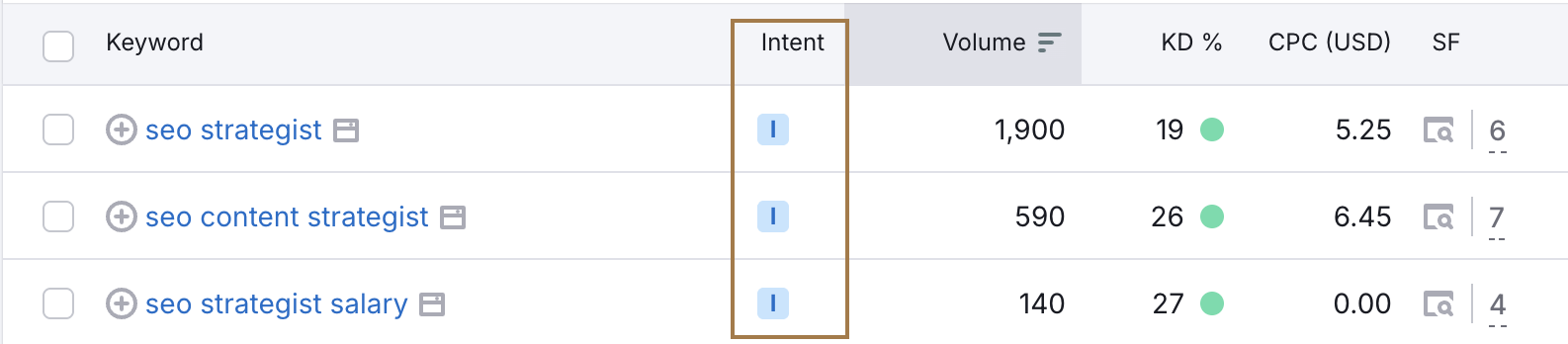
The ‘I’ stands for “informational” meaning the user wants to find an answer to a specific question. If the intent was labeled with a ‘C’ – “commercial” this would tell us that the user is looking for brands and services related to the keyword.
✅ Choose One Primary Keyword Per Page
Here’s where a lot of people go wrong when it comes to SEO… they try to target multiple keywords on the same blog post or page on their website.
One of the most important things to know about SEO is that each blog post or page on your website should focus on ONE main keyword! This helps search engines clearly understand the purpose of the content and prevents keyword overlap across your site.
Supporting keywords and related phrases can be used naturally throughout the content, but your primary keyword should guide the structure, headline, and overall topic.
✅ Check What’s Already Ranking
Your SEO tool gives you a lot of information, but before finalizing a keyword, it’s smart to actually search it on Google yourself and review the top results. This gives you insight into what type of content is already ranking and whether your perspective can add value.
If the results are dominated by large websites or directories, the keyword may be too competitive, but if the content feels outdated or surface-level, that’s often an opportunity to create something more helpful and relevant.
✅ Write Content That Prioritizes Clarity Over Perfection
When it comes to SEO, it’s important not to get so caught up in the data that you lose the human side of your content. You don’t need to obsess over every keyword placement or try to make every blog post or website page “perfect.”
The real goal is for your content to sound natural, authentic, and aligned with your voice with a layer of SEO strategy thoughtfully mixed in.
For example, if you’re writing a blog post about anxiety support, you don’t need to force the phrase “anxiety therapist near me” into every paragraph. Instead, focus on clearly answering the questions your clients are already asking, and naturally incorporate relevant keywords where they make sense!
When your content is clear, helpful, and written for real people first, SEO works best as a supportive tool rather than something that feels restrictive or robotic.
✅ Review and Refine Over Time
Lastly, remember that keyword research isn’t a one-time thing. It’s something that you should continue to do overtime as your practice grows and evolves!
As you continue to create new content for your website (through blogs or other resources), make sure that you’re taking the time to review your keywords and add new ones to your strategy.
This ongoing process allows your website to remain relevant, visible, and aligned with your business goals.
Done-for-you SEO Research for Private Practice Clinicians
Even with this keyword research checklist, we know that it can feel overwhelming to do this yourself, so if you’re the type of person that likes to outsource and have the hard part done for you, that’s what we’re here for!
At Studio Adagio, our SEO services are designed for every stage of growth – whether you simply want the roadmap or would rather someone drive the whole process for you. We have three different SEO service options that you can choose from and they’re all tailored to helping private practice clinicians finally start showing up in search!
If you have the keyword research under control and are looking for additional resources to help improve your, private practice SEO, we’ve got you covered there too: