


When you hear the term “SEO,” your mind probably jumps to one thing… blogging. And while it’s true that blogging is a big part of SEO for therapists, it’s not the only thing that helps you rank in Google search results.
SEO is about way more than just the content and keywords on your website. It’s also about the design of your website as a whole! And that’s the piece that soooo many people overlook.
When you’re only concerned about optimizing the content on your website and fail to optimize your website design for the best user experience, you’re likely missing out on a ton of SEO juice without even realizing it.
And that’s exactly why this blog post is so necessary! As a therapist hoping to boost your search result rankings, here at Studio Adagio, we don’t want you to miss crucial parts of your SEO strategy.
So in this post we’re going to cover why SEO for therapists matters in the first place and the connection between web design and SEO!
Why SEO for Therapists Matters
At Studio Adagio, we talk a lot about the importance of SEO for private practice clinicians, but in this blog post we want to share more about why SEO matters for therapists specifically.
A lot of times people correlate SEO with simply being found by more people online. And while it’s true that SEO is important to boost your visibility, our goal with our therapist clients is never to just get you more website traffic.
Instead, we want to ensure you’re being found by the RIGHT people – aka people who are truly interested in the content you share and the services you offer and often the people who will eventually turn into more than just a website visitor or a follower, but ideally a lead and client.
As a therapist, you’re often in a unique position to benefit from SEO because you’re likely serving clients in your local area, which means with the right strategy you can position yourself as the best answer for those searching for “therapists near me.”
This is where local SEO comes into play and is something that shouldn’t be overlooked by therapists specifically!
Beyond greater visibility, SEO for therapists also builds credibility because when a potential client sees your practice at the top of Google search results, it signals authority, trustworthiness, and professionalism.
But here’s where your website design starts to matter…
Someone finding you on Google thanks to your SEO efforts is one piece of the puzzle, but the other piece is actually holding their attention once they finally click through to learn more.
And a website that looks clunky, loads slowly, or is hard to navigate isn’t exactly going to be the thing that keeps them around.
Not only do these website design elements matter from a potential client perspective, but Google itself also takes into account user experience, site structure, and page performance when ranking websites.
If you haven’t intentionally designed your therapist website in conjunction with your SEO strategy, Google may push it lower in search results, meaning fewer clients will find you.
So ultimately yes – SEO for therapists matters, but it works best when paired with a well-designed website!
The Connection Between Web Design and SEO for Therapists
Now that you have a clear understanding of why SEO for therapists matters so much, let’s dig in further to your web design and SEO connection.
Like mentioned above, when it comes to SEO it’s not just about using the right keywords and publishing valuable blog content. While both of those things do play a big role in your SEO results, Google is also evaluating how your website functions.
The reality is that if your website design creates a poor user experience, your SEO will struggle no matter how strong your content is!
Here are a few key ways web design and SEO intersect:
Site Speed and Performance
Google prioritizes websites that load quickly because fast websites create a better user experience. If your website is weighed down by oversized images, unnecessary plugins, or poorly optimized code, it can slow down significantly.
When a site takes too long to load, visitors often leave before even reading your content, which means you could have the BEST therapy content and resources out there, but if your site speed is out of whack, it’s rare that anyone will ever find it.
A well-designed therapy website keeps load times fast so both search engines and potential clients can access your content easily.
Mobile Responsiveness
Did you know that more than HALF of all website traffic now comes from mobile devices?! This really shouldn’t come at a shock and it’s definitely not something to overlook.
This ultimately means that Google primarily evaluates websites based on their mobile performance. If your website isn’t mobile-friendly – think text that’s too small, buttons that are hard to click, or layouts that break on smaller screens – visitors will quickly leave your site.
Not only does this create frustration for potential clients searching for therapy support, but it also signals to Google that your site isn’t providing a great user experience, which can negatively impact your SEO rankings.

Clear Navigation and Hierarchy
Next up, your website’s navigation plays a huge role in how both users and search engines understand your content. If your menu is confusing or important pages are buried several clicks deep, it becomes harder for Google to crawl and index your site properly.
Clear navigation, organized pages, and logical site structure make it easier for search engines to understand what your website offers. It also helps potential clients quickly find information about your services, specialties, and how to book an appointment!

Content Placement and Headings:
Speaking of site structure, the way actual content is structured on your website also affects SEO. Using clear heading structures (like H1, H2, and H3 tags) helps Google understand the main topics of each page.
For example, your H1 heading typically tells Google the primary focus of the page, while subheadings organize supporting content.
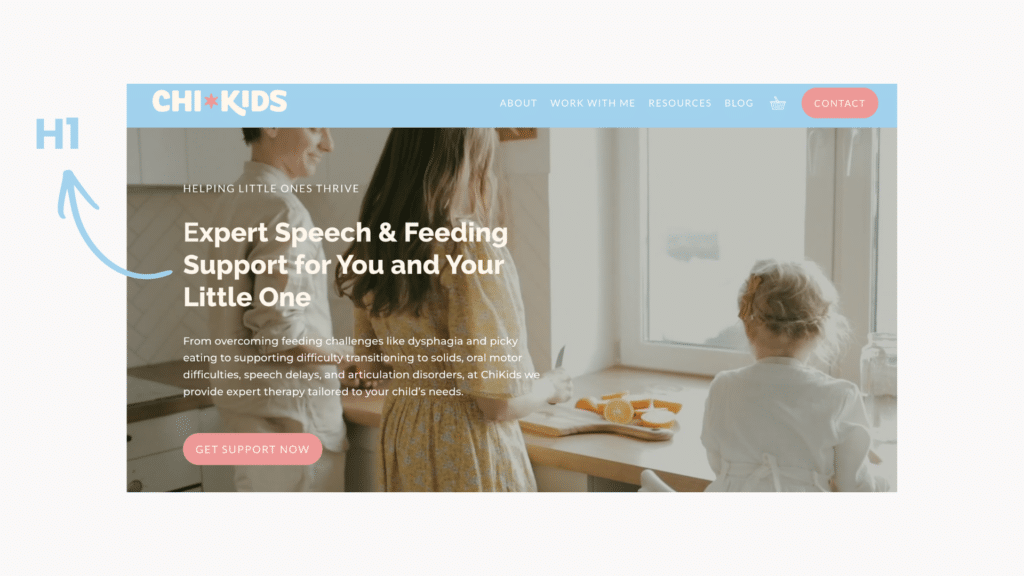
This structure not only improves search engine understanding but also makes your pages easier for visitors to scan, which keeps them engaged longer!
Image Optimization
Lastly, images are an important part of therapy website design and like everything else on your website, they need to be optimized correctly.
Large image files can slow down your website, which negatively affects performance and SEO. Luckily, this is an easy fix! You can compress your website images to help maintain visual quality while improving load speed.
Additionally, adding descriptive alt text to images helps Google understand what the image represents and improves accessibility for users who rely on screen readers!
Ultimately, your therapy website design isn’t just about aesthetics – it’s about creating a structure that supports both your visitors and your SEO strategy.
When your design is intentional, user-friendly, and optimized behind the scenes, it becomes much easier for Google to recognize your website as a valuable resource for people searching for therapy services.
Custom Website Design for Therapists
At the end of the day, improving your SEO as a therapist isn’t just about publishing more blog posts or sprinkling in the right keywords – it’s about creating a website that’s strategically designed to support both your audience and search engines.
When your website design is built with SEO in mind from the start, everything works together more effectively!
And that’s exactly why investing in custom website design can make such a big difference for therapists who want to grow their private practice through organic search.
Instead of forcing your SEO strategy to fit inside the limitations of a generic template, a custom website allows your design, content, and SEO strategy to work together seamlessly.
At Studio Adagio, we design and develop strategic, high-converting websites for therapists – whether you’re just launching your practice or long overdue for a website that matches your growth, our process makes it easy to show up online authentically and confidently.
We have various custom website design packages, so you can choose the one that’s best fit for your needs at the time. So, if you’re ready for a website that supports your visibility, reflects your expertise, and is built with long-term SEO growth in mind, we’d love to meet you!