


When it comes to SEO, there are soooo many terms that are constantly being thrown around and honestly, even if you’re in the world of marketing, it can still be confusing sometimes.
I can only imagine how it feels if you’re not in the marketing world – it’s like what does that even mean and is it really even important?
That’s exactly why we created our SEO Glossary of Terms! We wanted to help simplify some of the most common language you’ll come across when you hear about SEO.
But we want to take it a step further and dig into something that isn’t talked about nearly as much: on-page SEO for therapist websites.
When most people think about SEO, they think about blogging, keywords, meta descriptions, and rankings on Google. And while those are important, they mostly focus on strategy and research.
What often gets overlooked is the actual application – aka how your website is set up and optimized to support those efforts. That’s where on-page SEO comes in!
If you’re a therapist with a website, understanding on-page SEO for therapist websites can make a huge difference in how easily potential clients can find you and how effectively your website turns visitors into inquiries.
Because at the end of the day, it’s not just about getting traffic – it’s about making sure your website is actually set up to support that traffic.
What Is On-Page SEO for Therapist Websites?
First things first, let’s get clear on what on-page SEO for therapist websites even is!
On-page SEO refers to all of the optimizations you make directly on your website to help search engines understand your content and rank it accordingly.
In simpler terms, it’s everything happening on your site that impacts your visibility on Google.
For therapists, this includes things like:
- The words on your website (your copy)
- The way your pages are structured
- Your headings and keywords
- Your page titles and meta descriptions
- Your images and how they’re labeled (this is where things like alt text come into play!)
- Your internal linking strategy
Overall, on-page SEO for therapist websites is all about making sure your site is clear, organized, and aligned with what people are actually searching for.
Because even if you offer incredible services, if your website isn’t optimized properly, it can be hard for search engines to understand when (and where) to show your site in search results.
On-Page SEO vs. Off Page SEO
Now that you have a better understanding of on-page SEO for therapist websites, it’s also important to fully understand the alternative – which is off-page SEO.
Again, it’s just another jargony term that sounds a little more complex than it actually is!
As mentioned above, on-page SEO is everything you control directly on your website, including:
- Your content
- Your page structure
- Your keywords
- Your website design and user experience
Off-page SEO, on the other hand, refers to actions that happen outside of your website that still impact your rankings.
This includes things like:
- Backlinks (when other websites link to yours)
- Online directories (which is a great local SEO strategy!)
- Social media signals
- Guest features or collaborations
Both are important, but if your on-page SEO isn’t strong, your off-page efforts won’t be nearly as effective!
A great way to think of it is that your on-page SEO is what builds the foundation and then your off-page SEO builds authority on top of that!
On-Page SEO for Therapist Website Checklist
Without a solid on-page SEO foundation, everything else becomes harder to sustain, which is why we really encourage therapists that are looking to improve their SEO to start here FIRST.
Knowing the exact steps to take to improve your on-page SEO for your therapist website can sometimes be overwhelming though, so we want to remove that barrier for you and give you a very clear checklist to start with:
Clear and Strategic Use of Keywords
First and foremost, start with your keywords. Your website should include keywords that reflect what your ideal clients are actually searching for – meaning you aren’t making these things up!
For therapists, this might look like:
- “anxiety therapist in [your city]”
- “therapy for burnout”
- “couples counseling near me”
But again, don’t guess at these! This is where proper keyword research comes into play so you can know exactly what people are typing into Google.
Once you know your keywords, they should be naturally included in:
- Your page titles
- Headings
- Body content
- Meta descriptions
But remember: the goal isn’t to “stuff” keywords everywhere – that can actually cause you more harm than good!
Instead, use them naturally and intentionally so search engines can clearly understand your content and start ranking your pages on Google appropriately.
Strong Page Titles and Meta Descriptions
Next, pay attention to your SEO page titles and meta descriptions – this is the content that actually shows up in search results.

Both of these components of your on-page SEO for your therapist website should:
✔️ Clearly describe what the page is about
✔️ Include relevant keywords
✔️ Encourage people to click
This is often your first impression on Google, so it matters A LOT!
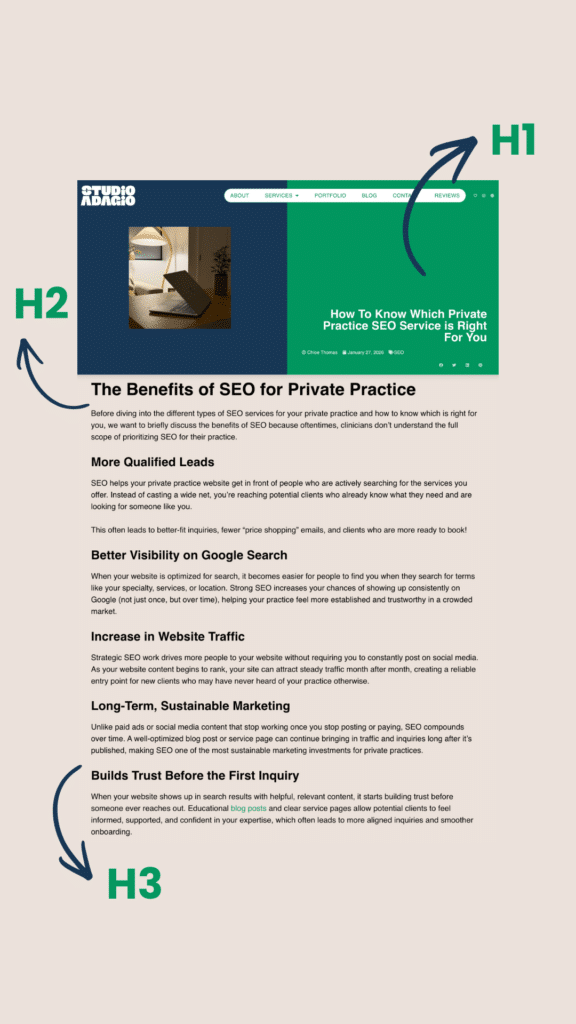
Proper Heading Structure (H1, H2, H3)
One thing that impacts SEO a ton that many people don’t realize is proper heading structure. The reason this matters so much is that your page headings help organize your content for both users and search engines.
Every page on your website (including your blog posts!) should have one H1 main heading followed by supporting H2s and H3s for structure.
Here’s what this looks like in action on a blog post:
Optimized Website Copy
Your website copy should be clear, intentional, and written with both your audience and SEO in mind. This means:
✔️ Speaking directly to your ideal client
✔️ Clearly explaining your services
✔️ Naturally incorporating keywords
✔️ Avoiding overly vague or generic language
Well-written website copy doesn’t just help you rank – it helps move your website visitors into real action, which is the ultimate goal!
Mobile-Friendly Design
More than HALF of all website traffic now comes from mobile devices, which means that Google primarily evaluates websites based on their mobile performance. If your website isn’t mobile-friendly – think text that’s too small, buttons that are hard to click, or layouts that break on smaller screens – visitors will quickly leave your site.
Not only does this create frustration for potential clients searching for therapy support, but it also signals to Google that your site isn’t providing a great user experience, which can negatively impact your SEO rankings.
Fast Loading Speed
Google also prioritizes websites that load quickly because fast websites create a better user experience. If your website is weighed down by oversized images, unnecessary plugins, or poorly optimized code, it can slow down significantly.
When a site takes too long to load, visitors often leave before even reading your content, which means you could have the BEST therapy content and resources out there, but if your site speed is out of whack, it’s rare that anyone will ever find it.
A well-designed therapy website keeps load times fast so both search engines and potential clients can access your content easily.
Image Optimization
Images are an important part of therapy website design and like everything else on your website, they need to be optimized correctly. Large image files can slow down your website, which negatively affects performance and SEO.
Luckily, this is an easy fix! You can compress your website images to help maintain visual quality while improving load speed.
Additionally, adding descriptive alt text to images helps Google understand what the image represents and improves accessibility for users who rely on screen readers!
Internal Linking
Internal links connect different pages on your website and are SUCH an important part of on-page SEO for therapy websites.
This often looks like linking from a blog post to a service page or linking between related blog posts.
Internal linking helps guide users through your site strategically, improving navigation, and strengthening your SEO by showing content relationships.
Clear Calls-to-Action
When someone visits your website and starts scrolling through your pages, it should be so obvious what they should do next.
They should never have to guess or have to search for information on how to book a consultation, fill out a contact form, or learn more about a service. It should be designed and written in a way that’s plain and simple!
Clear calls-to-action on your website improve both user experience and conversions, which indirectly supports your SEO over time.
Clean, Organized URL Structure
Lastly, here’s one that people often forget to double check because it’s not technically on the page of your content, but it IS considered on-page SEO.
Your page URLs play a huge role in your SEO and you have the ability to change every URL slug to ensure that it’s clean, clear, and easy to understand.
These are examples of how you want your page URLs to look:
- yourwebsite.com/anxiety-therapy-north-carolina
- yourwebsite.com/couples-counseling-services-raleigh
These are clear, keyword-rich, and easy for both users and search engines to understand.
The opposite of this might look something like:
- yourwebsite.com/page-id-4837?ref=services
- yourwebsite.com/services1/general-info-final
These types of URLs don’t clearly communicate what the page is about and can make your site feel less organized (to both users and search engines).
While page URLs matter for every page on your website, you especially want to pay close attention to them for your blog posts. Since blog titles tend to be longer, it’s important to shorten and simplify the URL so it still clearly reflects the topic without becoming overwhelming.
For example, a blog title like: “How Therapy Can Help with Anxiety and Burnout in Working Moms”, shouldn’t turn into a long, clunky URL like: yourwebsite.com/how-therapy-can-help-with-anxiety-and-burnout-in-working-moms
Instead, you can shorten it to something clean and keyword-focused like: yourwebsite.com/anxiety-therapy-working-moms or yourwebsite.com/anxiety-and-burnout-therapy.
This keeps your URLs easy to read, easy to remember, and still aligned with what your ideal clients are actually searching for!
On-Page SEO for Therapist Website Services
If you’re reading through this list and thinking, “Phewww, this is a lot,” honestly, you’re not wrong!
On-page SEO for therapist websites involves many moving pieces and it’s not always easy to know what to prioritize first or how to implement everything effectively.
That’s exactly why we offer on-page SEO services for therapistshere at Studio Adagio.
Because again, your website shouldn’t just exist – it should actively be working for you by bringing in conversions. And if it’s not doing that, then it’s a big sign that something’s off!
Our approach to SEO goes beyond just keywords. While that’s of course a big part of SEO work for our clients, we start by looking at the full picture, including:
- Your website structure
- Your messaging and copy
- Your user experience
- Your technical setup
This helps us know what’s working, what’s not, and allows us to give you clear guidance on what to do next!
Whether you need a full website refresh, strategic copywriting, or ongoing SEO support, our goal is to help your practice get found by the right people and turn that visibility into real inquiries.
If you’re ready to improve your therapy website’s visibility and performance, CLICK HERE to explore our SEOand website servicesto get started!
And if you want a closer look at the behind-the-scenes process of working with us for SEO, click here to get the full rundown.